

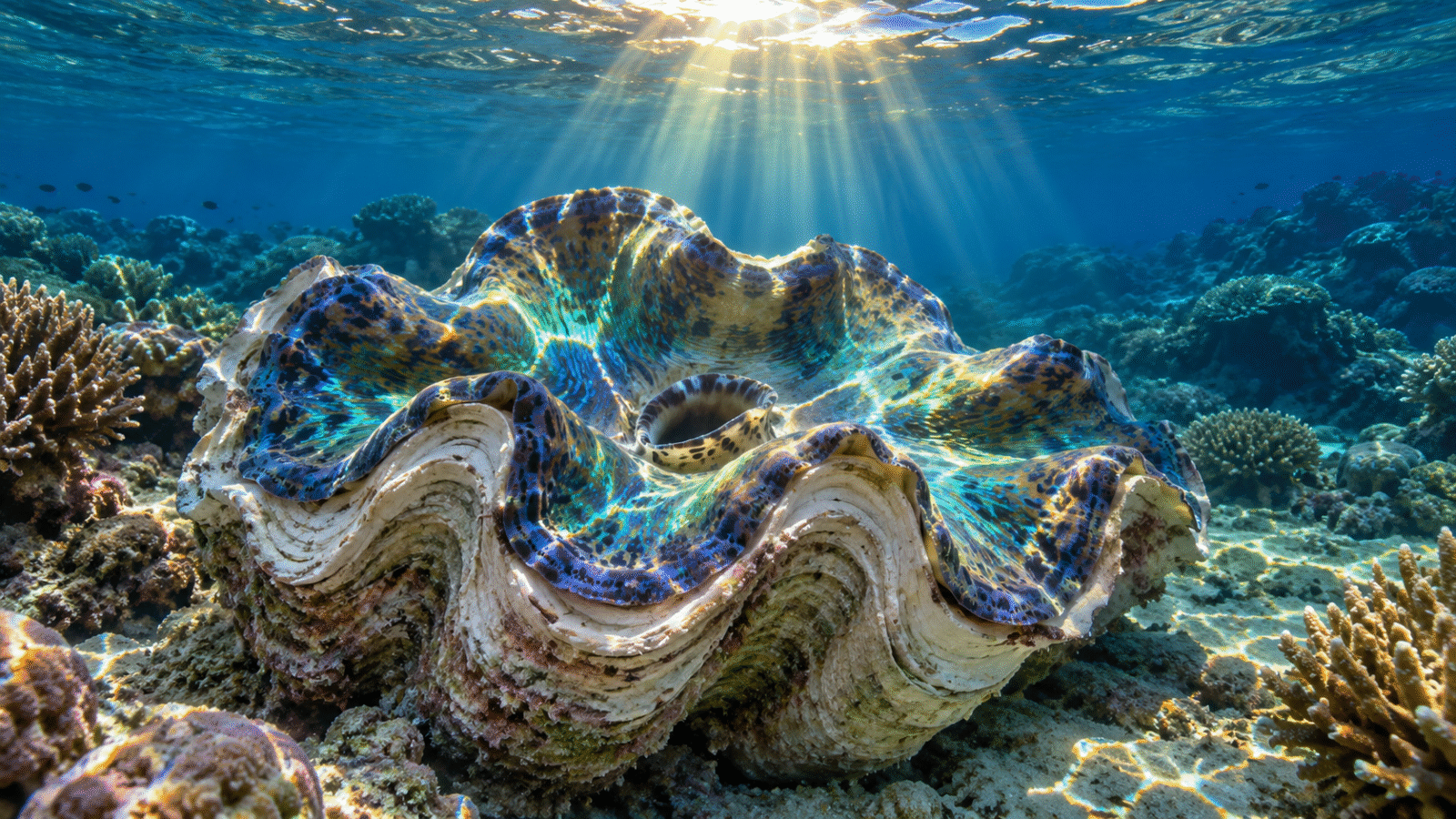
It’s time for another post on the wonders of life. Today it’s giant clams.
Giant clams (Tridacna) can be big –more than a meter across – and old – some live for a century. But what’s really special, and what requires a Designer, is how they use solar energy.
They get most (roughly 65–70 percent) of their nutrition from single-celled algae (Symbiodinium”) that live inside their tissues. The algae are not scattered randomly. They are arranged in narrow vertical columns, each about a tenth of a millimeter wide, oriented parallel to incoming sunlight. Above them sits a layer of specialized cells called iridocytes. These cells produce the clam’s vivid iridescent colors through precise structural interference rather than ordinary pigments. More importantly, they scatter and filter intense tropical sunlight so that light “wraps around” the algal columns and illuminates them evenly deep into the tissue. The interior of the clam therefore remains relatively dark—almost all usable light is absorbed for photosynthesis rather than reflected away. The same system also helps protect the algae from damaging heat and excess light.
Researchers at Yale have modeled this three-dimensional arrangement. Their calculations show that the fixed geometry alone can achieve a quantum efficiency of about 43 percent —well above the typical 20–25 percent efficiency of large commercial solar arrays and far above the roughly 14 percent efficiency of a leaf. But giant clams do even better. They adjust the spacing of the algal columns throughout the day. When this dynamic optimization is included, modeled quantum efficiency rises to about 67 percent. In other words, the clam-algae partnership converts a remarkably high fraction of available sunlight into usable chemical energy under the harsh conditions of equatorial reefs. The giant clam is about three times as energy efficient as the best man-made solar panels.
The system requires coordinated features: precisely spaced algal columns, a specialized light-scattering layer that both enhances and protects, a mutualistic partnership with the algae in which each partner supplies what the other needs, and a mechanism that adjusts geometry in real time to changing light. Remove or degrade any major part and efficiency collapses. Gradual, unguided processes would have to assemble and fine-tune all these elements together while the organism remained viable at every step—an extremely demanding requirement for which no detailed evolutionary pathway has been demonstrated.
Giant clams showcase design. Their optimized solar-energy system, which human engineers are still trying to copy, can only be explained as the product of an intelligent Designer. That Designer is the God who created the world and everything in it, including these remarkable living power plants of the reef.
Thanks for reading. Please share the good news that true science requires a Designer and a Creator. I invite you to share this post, and my blog. There are and never will be any ads.
Thanks for reading,
Doug Ell