

In the spring of 1621, the surviving Pilgrims at Plymouth were still recovering from a brutal first winter. Roughly half of the original company had died. Food was scarce, the ground was unfamiliar, and relations with the surrounding Native peoples were uncertain. Then, one March day, an Indian walked boldly into their settlement and greeted them in broken English. His name was Samoset. He told them of another man, Squanto, a native of that very place who could speak English even better.
A few days later, Squanto arrived. To the astonished Pilgrims, the sight of an Indian speaking their language seemed almost miraculous. Governor William Bradford later wrote that Squanto “became a special instrument sent of God for their good beyond their expectation.” He showed them how to plant corn, where to catch fish, and how to fertilize the exhausted soil by placing fish in each hill of corn. He taught them how to catch eels and the best places for lobsters. He guided them to places they had never seen and served as interpreter in negotiations with Massasoit, the Wampanoag sachem. The resulting peace treaty held for decades.
What made this help so extraordinary was Squanto’s own history. Years earlier, he had been captured by an English captain, Thomas Hunt, and taken to Spain to be sold into slavery. A Catholic Priest purchased Squanto, educated him, and sent him to an English merchant in London who would help him get home.
It took perhaps three years to find a ship to take him home. In those years Squanto learned English and the ways of the English. He reached home in the Spring of 1619 – his ship landed in the same part of what is now Massachusetts where Squanto grew up — only to discover that his entire Patuxet village had been wiped out by disease. The very ground where the Pilgrims had settled had once been his people’s home. Alone among his tribe, he stood ready to assist the newcomers.
Bradford and the other settlers recognized the hand of Providence in this chain of events. The evil intentions of a slave trader, the long years in a foreign land, and the tragic loss of Squanto’s people had all been turned, in God’s timing, into the means of the colony’s survival. The parallel to Joseph in Egypt was clear to them: what men meant for harm, God meant for good, to preserve many lives (Genesis 50:20).
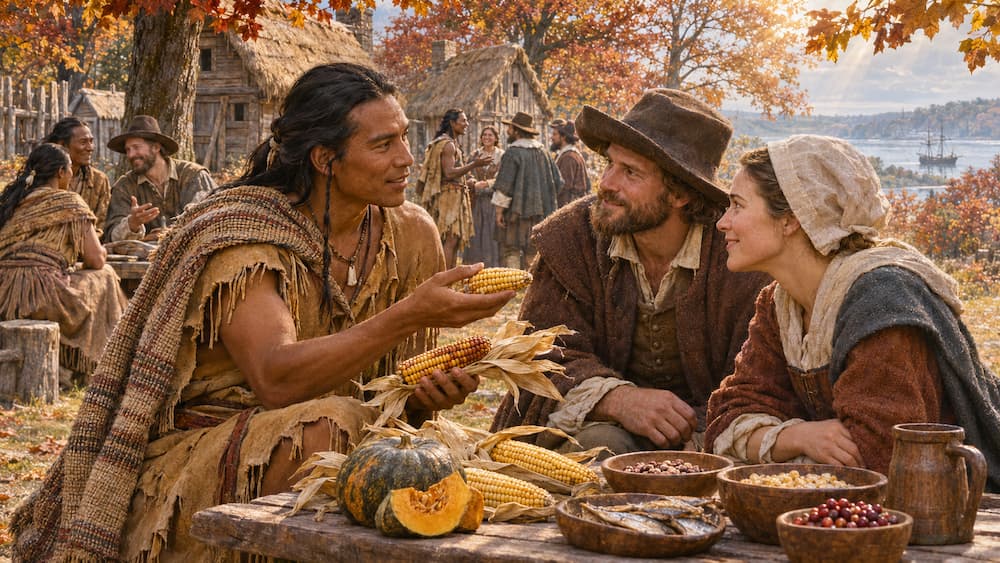
That same year, after the harvest Squanto had helped make possible, the Pilgrims held a three-day feast of thanksgiving. Massasoit and about ninety of his people joined perhaps 50 surviving Pilgrims. Squanto was there as interpreter and friend, bridging two very different worlds at the table. The meal we now call the First Thanksgiving was not simply a celebration of crops; it was a direct result of the unexpected help God had sent through one man who walked out of the woods speaking English.
Squanto stayed with the Pilgrims until his death in late 1622. On his sickbed he asked Bradford to pray that he might go to the Englishmen’s God in heaven. His departure was felt as a great loss. Without his practical knowledge, his language skills, and the trust he helped establish, the fledgling settlement might not have endured its second winter—and the tradition of Thanksgiving that began that autumn might never have taken root.
As we gather on Thanksgiving Day, we remember more than turkey and family. We remember a God who can turn captivity into deliverance, loneliness into friendship, and an English-speaking Indian walking out of the forest into the survival of a colony. The Pilgrims saw Squanto as a special instrument sent beyond their expectation. Their gratitude points us to the same Provider today.
This story is special to me. I am descended, on my mother’s side, from Governor Bradford and two other pilgrims who came over on the Mayflower.
Have a great Thanksgiving.
Doug Ell