

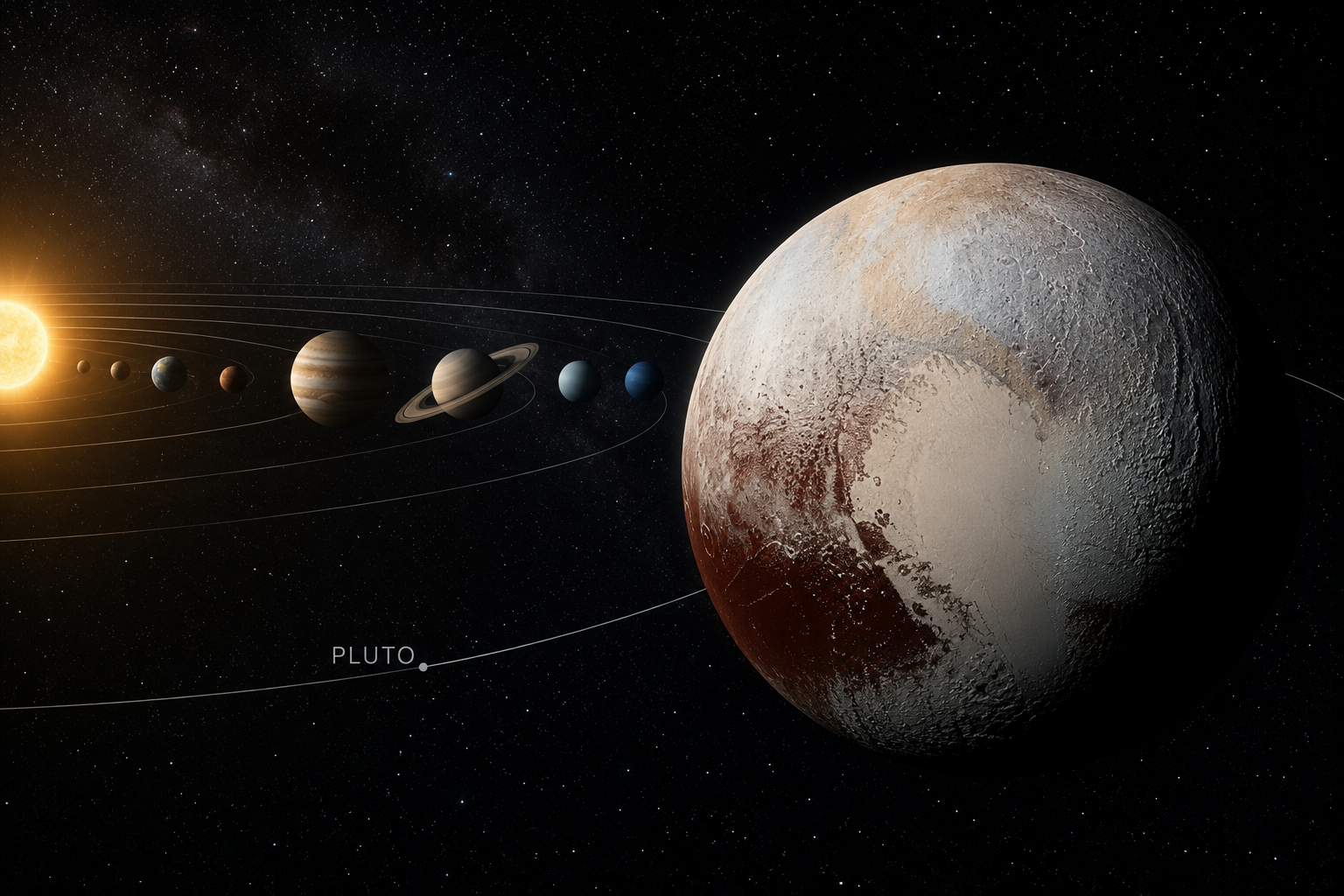
I’m not sure why, but Pluto makes me smile. Perhaps I think of Mickey’s dog. But there’s also something funny, certainly at least in the sense of being very odd, about the lonely object at the far reaches of the Solar System.
Pluto is, on average (we’ll come back to its orbit later) about 40 times as far from the Sun as Earth. It weighs about 1/500 of what Earth weighs, has a diameter of about 1/5 Earth’s diameter and 2/3 of the Moon’s diameter.
It’s a ball of rock and ice 6 billion miles away. Very little sunlight and not enough mass to hold onto any heat. Pluto is stone cold dead, right?
Wrong! In 2015, when NASA’s New Horizons probe passed near, we learned Pluto is a happening place. Pluto has ice mountains over two miles high. Some may be ice volcanoes. Pluto has a vast flat ice plain (called Sputnik Planitia) that has evidence of glacial flow and is clearly geologically active. It is completely unblemished by meteorite impacts.
Pluto has a thin but surprisingly extended nitrogen atmosphere with haze layers stretching hundreds of kilometers high. Pluto’s low gravity (about 7% of Earth’s), coupled with heating by ultraviolet light from the sun, allows hundreds of tons of Pluto’s atmospheric nitrogen to escape into space each hour. So how, after the alleged billions of years, does it still have an atmosphere of mostly nitrogen?
Bottom line, Pluto can’t be billions of years old.
Pluto also has a weird orbit. My early science books had images of how secular scientists think our Solar System was formed. Supposedly around 4.5 billion years ago there was a swirling pancake-type disk, the Sun formed out of the center mass, and the planets gradually formed out of the more distant pieces of the rings, all of course rotating in the same direction within the same plane.
Pluto’s orbit is 17 degrees off from that plane. It is highly elliptical, for 20 of it’s 248 Earth years orbit Pluto is closer to the Sun than Neptune. Pluto’s five moons are also funny. They all rotate at different speeds, and one, Nix, rotates backwards.
Funny, isn’t it? Thanks for reading,
Doug